
Case Study
Metal Additive Manufactured Parts Produced by SOLIZE Used in Int-Ball2, an Onboard Drone Supporting Astronauts Aboard the International Space Station
Research and Development
JAXA
About Int-Ball2
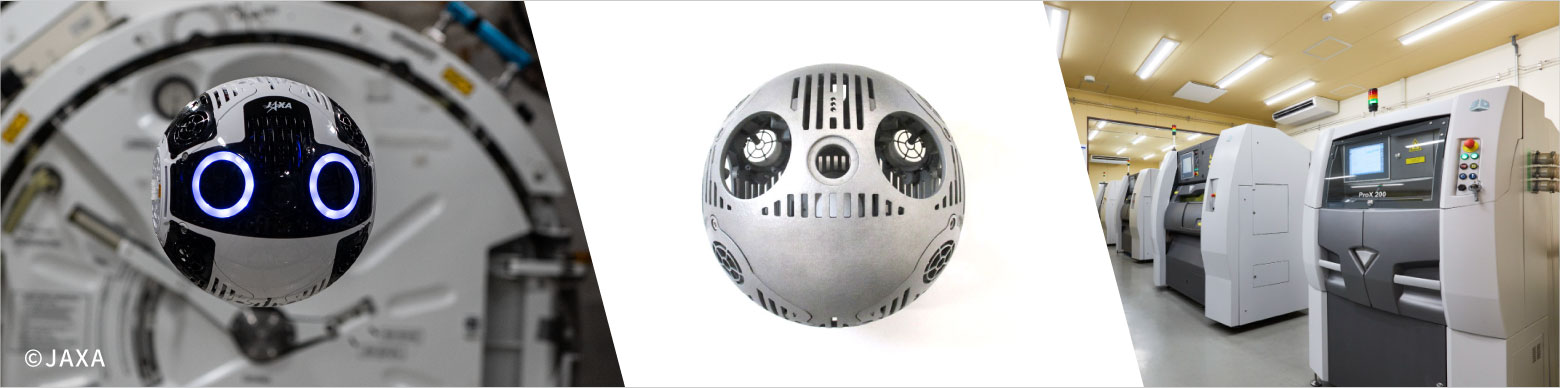
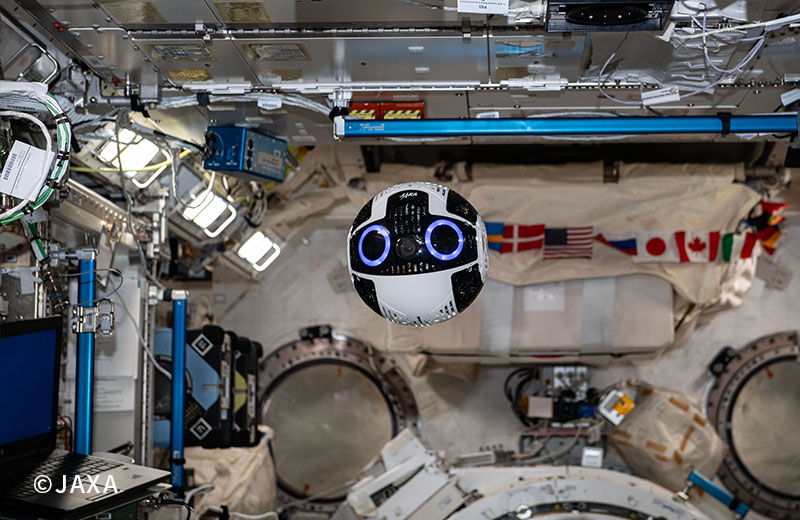
Developed by JAXA and currently in operation, Int-Ball2 is a robot that flies in the microgravity environment inside the International Space Station (ISS). Operated by ground-based controllers, it takes photographs and videos on behalf of astronauts. Its purpose is to reduce the time astronauts previously spent taking photographs and preparing for photography, allowing them to devote more time to creating new value.
Based on the knowledge gained from the first model, Int-Ball, Int-Ball2 incorporates a range of performance enhancements and other improvements. These include a function that enables it to automatically return to its docking station and recharge, a function for controlling its attitude inside the ISS, where air currents are constantly present, and an autonomous flight function.
Producing the Housing of Int-Ball2 Through Metal Additive
Manufacturing
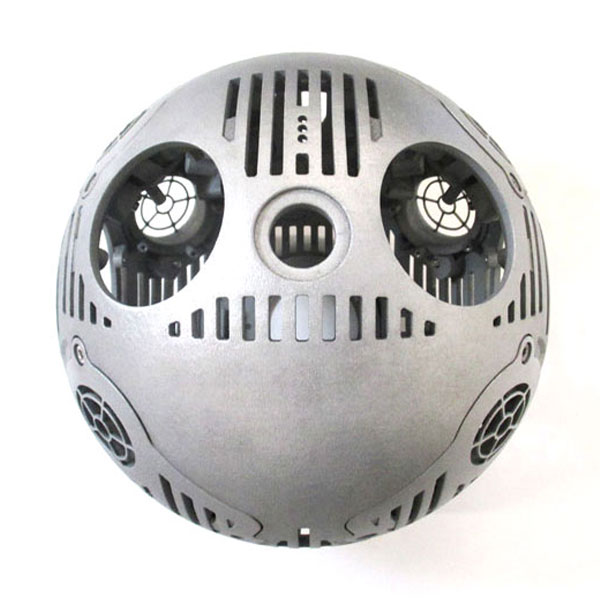
Because Int-Ball2 operates within the limited space of the space station, its housing needed to be compact, lightweight and strong and therefore had to be made of metal. In addition, the increase in size from the first model required measures to address flammability. Since the first model had also been produced using a 3D printer, metal additive manufacturing was the most suitable production method.
Meisei Electric Co., Ltd. was commissioned by JAXA to design and manufacture the housing for Int-Ball2, while SOLIZE was commissioned to manufacture the aluminum parts using metal additive manufacturing. Despite the limited schedule, SOLIZE established product specifications aligned with the customer’s needs and delivered parts that met the required quality, cost and delivery requirements. SOLIZE also proposed and implemented measures to minimize secondary processing.
Challenges
- Determining the appropriate clearance settings and necessary post-processing for accurately assembling 14 parts.
- Ensuring accuracy and durability for repeated assembly and disassembly.
- Determining how to handle fine slits and thin-walled sections.
- Limited time available for manufacturing, from product design through completion.
SOLIZE’s Proposals and Response
- Produced parts for assembly verification using powder-bed additive manufacturing, and conducted assembly tests in advance.
- Used ILISERT threaded inserts in screw sections expected to be repeatedly removed, ensuring durability and maintainability.
- For complex shapes with fine slits and thin walls, proposed build orientation, optimized support design, and added wall thickness to ensure manufacturability.
- Proposed clearance settings that enabled assembly without machining, thereby minimizing secondary processing and shortening the delivery schedule.
Int-Ball2 Equipped with Metal Additive Manufactured Parts
Produced SOLIZE Began Operation on the ISS in June 2023
After all the metal additively manufactured parts had been successfully assembled, Int-Ball2 underwent ground-based pre-launch verification for use on the ISS and was launched to the ISS on June 6, 2023. Initial functional verification on the ISS has also been completed, and Int-Ball2 is currently in use inside “Kibo” on the ISS.
In the aerospace field, lightweight and compact parts are required even for low-volume production. Using a metal 3D printer to produce parts for Int-Ball2 made it possible to reduce the cost and lead time associated with low-volume production. It also enabled the production of shapes that would have been difficult to manufacture using conventional methods, making it possible to reduce the product’s weight and size. Areas requiring precision, including those related to part assembly, were addressed through design-stage measures to improve accuracy and through secondary processing.
Drawing on the needs communicated by customers each day, SOLIZE continues to develop the underlying technologies required to realize products using 3D printers. These include additive manufacturing processes for thin-walled microstructures, design and manufacturing technologies for specialized functional structures such as topological, lattice and porous structures, and post-processing technologies optimized for 3D printing.
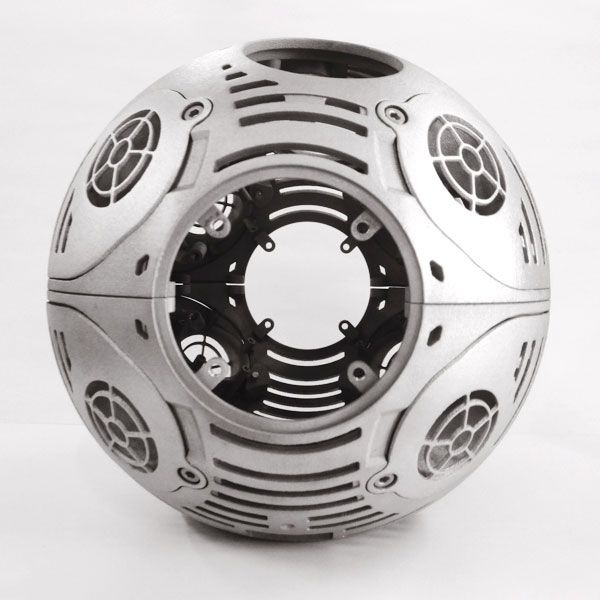
Outer components assembled.

© 2026 SOLIZE Corporation All Rights Reserved.