
SOLIZE Intellectual Property Strategy Group
Introduction of Patent Inventions #2
Drawing Difference Detection Technology Based on the Similarity of Shape Components
2026-08-20
Invention Overview
In manufacturing industries where design changes occur frequently, drawing reviews and drawing-check activities often require substantial effort, are susceptible to overlooked modifications, and tend to rely heavily on the experience of skilled personnel.
The present invention analyzes drawings at the level of shape components and automatically detects differences based on similarity between corresponding shape components. By improving the efficiency of design reviews and reducing the risk of overlooked changes, the technology contributes to higher quality, shorter development lead times, and the advancement of design digital transformation (DX).
Technology Overview ¹
¹ This explanation is intended to prioritize clarity and ease of understanding. Therefore, the steps described here may not correspond exactly to the actual processing sequence used in the system. In addition, the content presented in this article is provided for illustrative purposes and should not be interpreted as defining the scope of the patented technology.
Step 1: Determine the Comparison Unit (Shape Component)
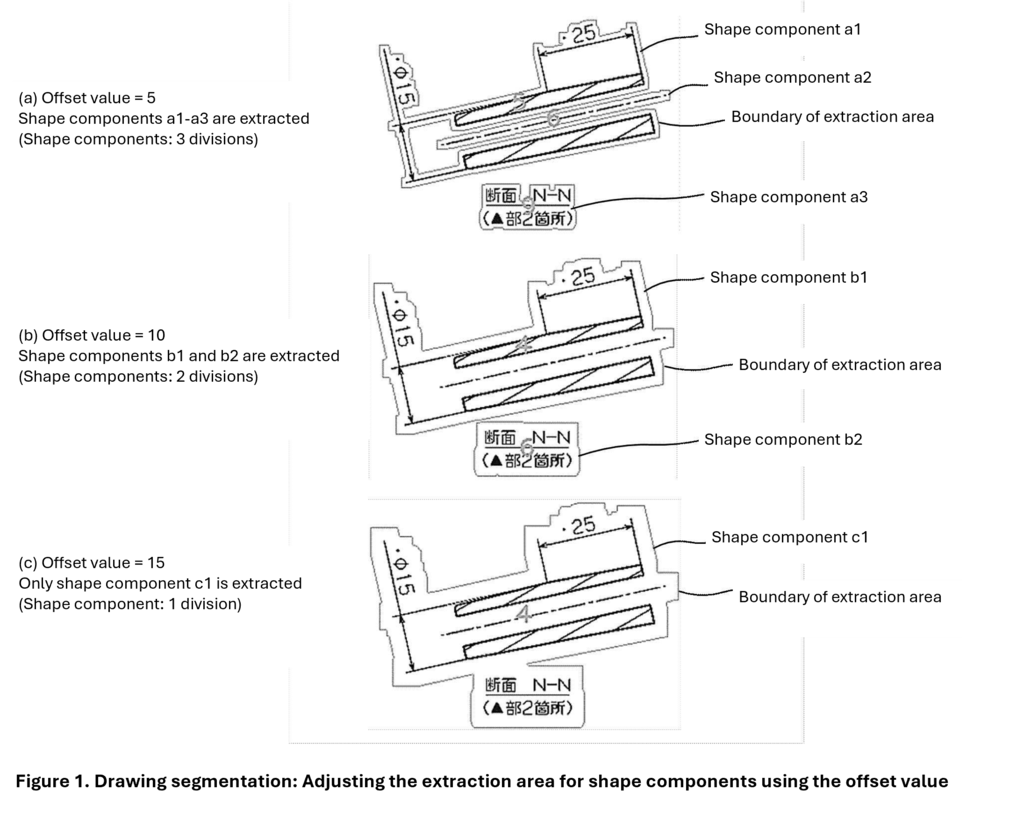
This technology allows the unit used to extract shape components to be adjusted according to the complexity of the drawing, enabling flexible application across a wide range of drawing types.
As shown in Figure 1, the extraction range treated as a single shape component can be modified by adjusting the offset value, defined as the distance between the actual geometry and the boundary of the extraction area.
In this example, increasing the offset value gradually consolidates the extracted geometry from three shape components into two shape components and ultimately into a single shape component.
By adjusting the offset value, shape components can be extracted appropriately from drawings ranging from densely detailed to relatively simple structures.
Step 2: Extract shape components from Drawings A and B
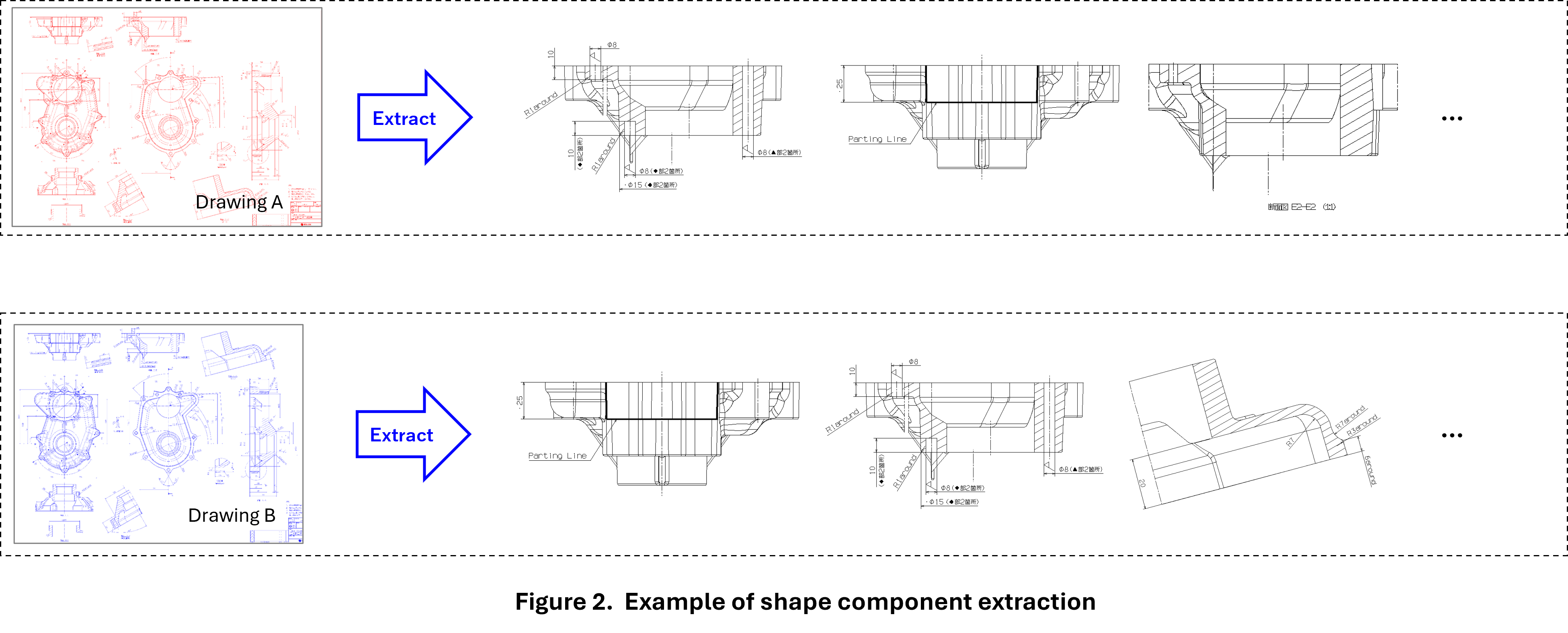
As shown in Figure 2, the shape components used for comparison are extracted from both Drawing A and Drawing B.
Step 3: Identify Corresponding shape components
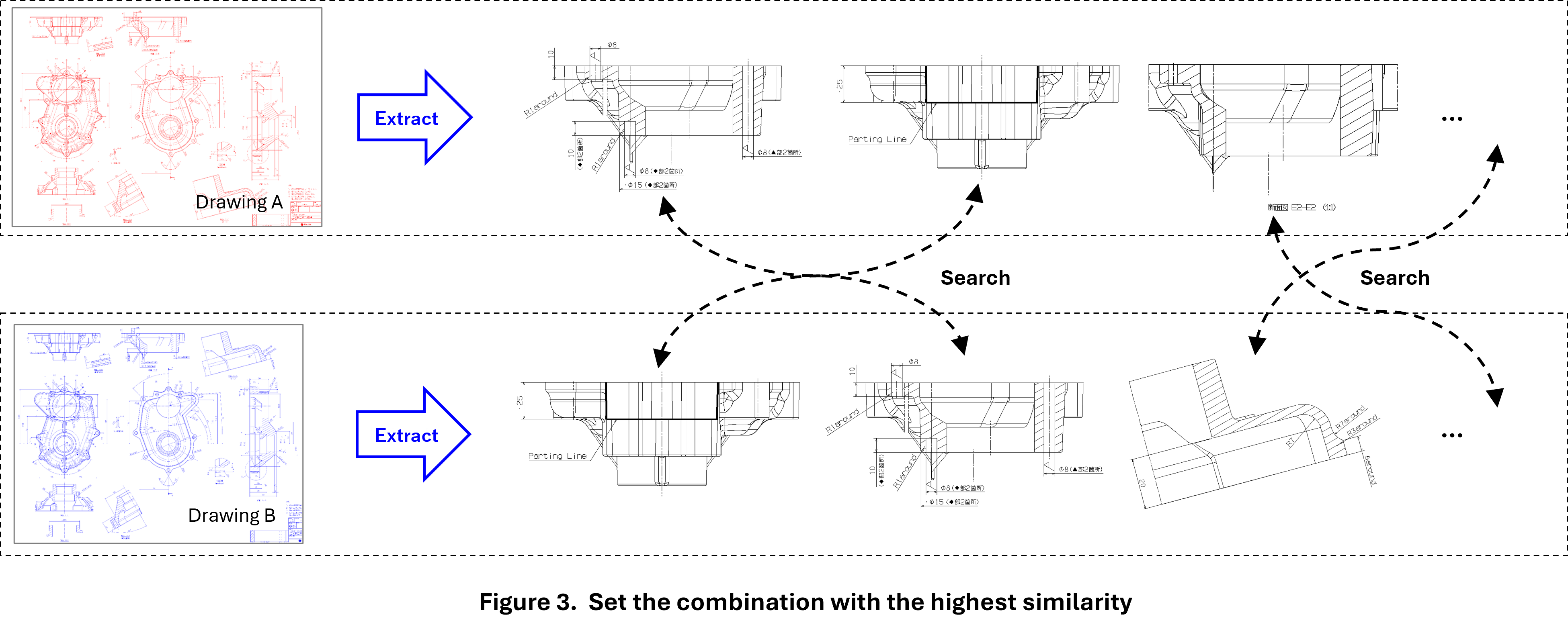
As shown in Figure 3, for each shape component, the corresponding shape component with the highest similarity² score is identified in the other drawing.
² Similarity is an index that indicates how closely two shape components match. The method used to calculate this index is not limited to a specific approach. In this example, similarity is expressed as a value between 0 and 1, with values closer to 1 indicating a higher degree of similarity.
Step 4: Classify Shape Components Based on Similarity
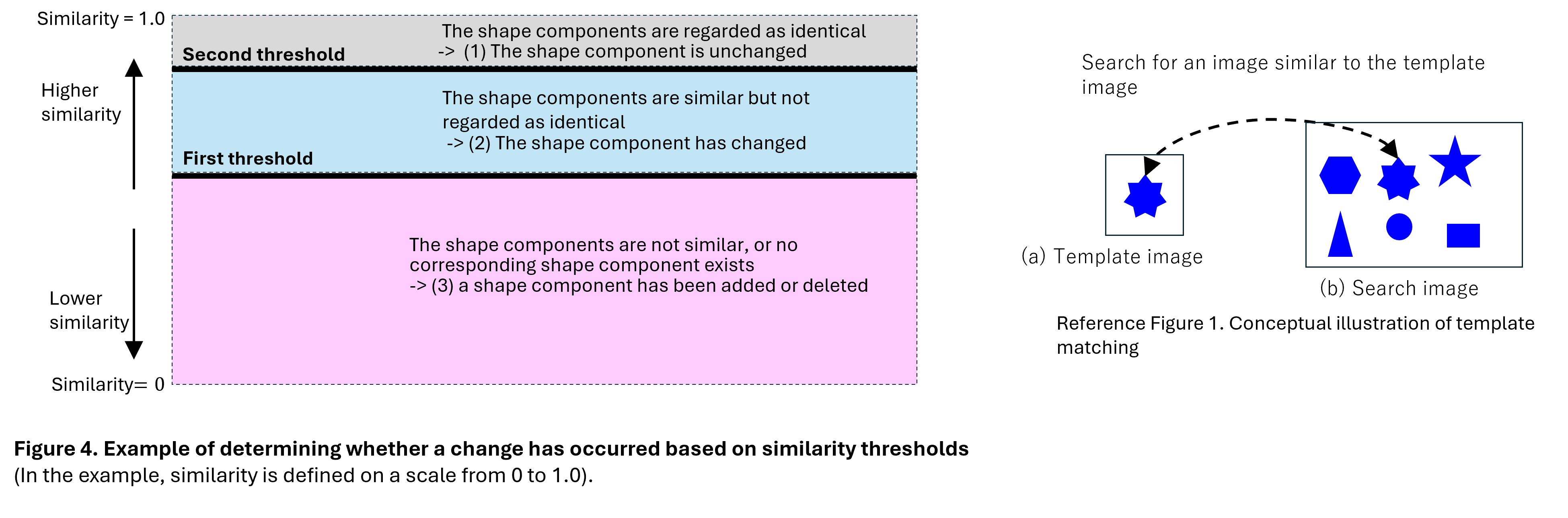
The method used to calculate similarity between shape components is not limited to any particular approach. For example, a well-known image-processing technique such as template matching³ (see Reference Figure 1) may be used to evaluate similarity.
As shown in Figure 4, each shape component can be classified based on its similarity score into one of the following categories:
- Unchanged
- Changed
- Deleted or added
³ Template matching is an image-processing technique used to search a target image for shapes that resemble a predefined template image (see Reference Figure 1).
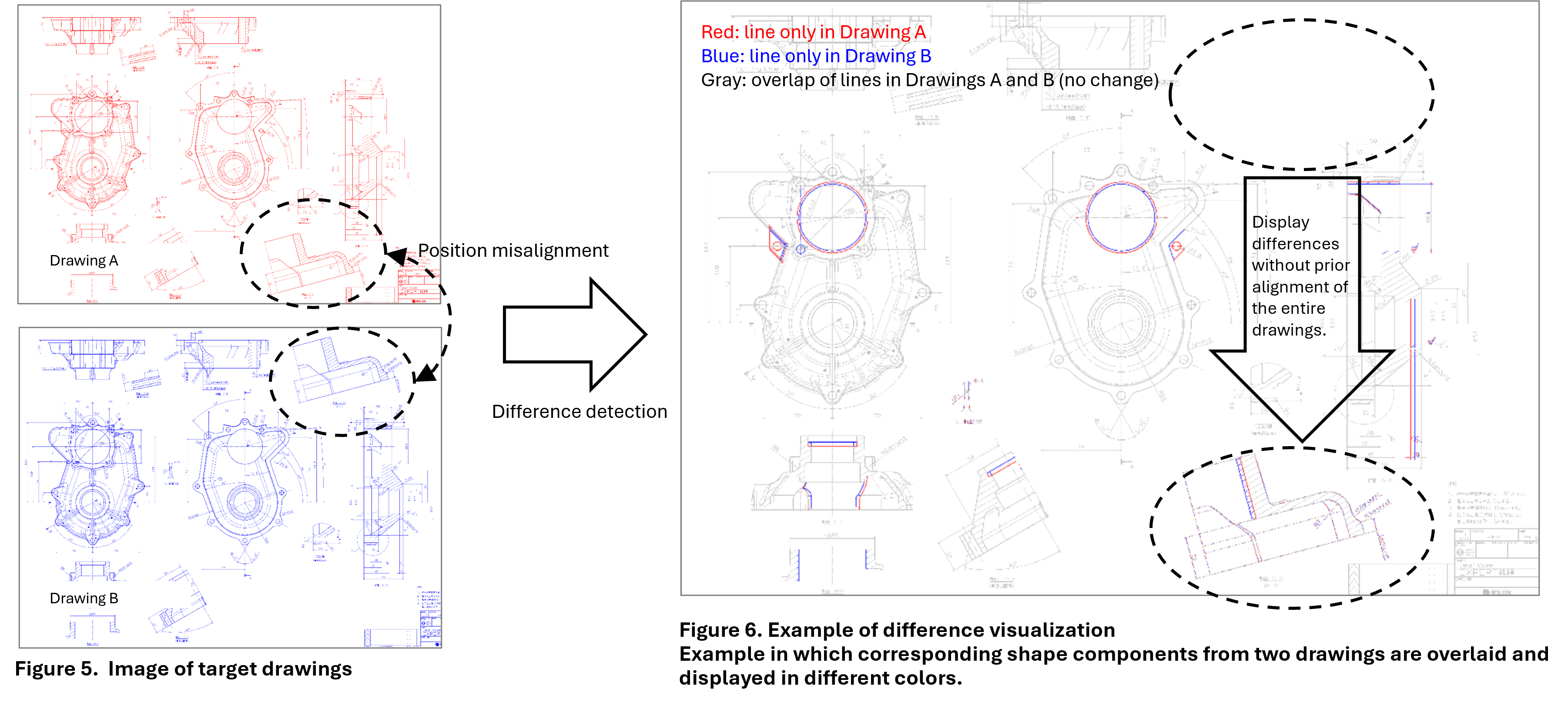
Step 5: Visualize the Detected Differences
This technology enables drawings to be compared without requiring prior alignment of the entire drawings. As a result, it can reduce the workload involved in reviewing differences and help ensure more consistent review results, regardless of the reviewer’s experience or skill level.
The detected differences may be visualized, for example, in the following ways:
- Differences between corresponding shape components are displayed
- Modified areas are displayed in different colors
- Unchanged shape components are displayed in a less prominent color, such as gray
- Corresponding shape components are overlaid after adjusting their relative positions
Summary of the Patented Technology
Conventional Method
In the conventional approach, two entire drawings are overlaid, and the differences are identified through visual inspection.
Challenges of the Conventional Method
This approach requires the drawings to be aligned before comparison. The review process also tends to rely heavily on the reviewer’s experience and skill, making it time-consuming and difficult to standardize.
Technology of the Present Invention
The present invention extracts shape components from each drawing and evaluates the similarity between corresponding shape components to determine whether they have been changed, deleted, or added.
Benefits of the Present Invention
The technology can detect changes at the shape-component level without requiring prior alignment of the entire drawings. This improves the efficiency of design reviews and drawing checks while helping to prevent overlooked changes and improve quality. Furthermore, the technology helps reduce variations caused by differences in reviewer experience and skill levels, thereby supporting more consistent review quality.
Potential Applications
Example Applications
This technology is expected to be applicable to the following types of work:
- Design change management and design support
- Difference comparison between drawings
- Detection of similar shape components
- Support for design reviews and CAD reviews
- Integration with drawing management systems
- Support for drawing audits
- Support for quality assurance activities
These are representative examples, and the scope of application is not limited to the items listed above.
Applicable Drawing Types
This technology can be applied to a wide range of drawings, including mechanical design drawings, circuit diagrams, printed circuit board layouts, architectural drawings, and other application-specific drawings. However, its use is not limited to these examples.
Potential Implementation Formats
The technology can be implemented in the following forms:⁴
- Drawing comparison software operating on a local device
- A cloud-based drawing comparison service operating on a server
- An embedded inspection system
⁴ The invention has been patented as an apparatus, method, and program.
Licensing and Technology Adoption Opportunities
Potential implementation targets include:
- Existing CAD and PLM/PDM systems
- Design review support systems
- Drawing audit solutions
SOLIZE PARTNERS welcomes discussions regarding licensing arrangements, OEM partnerships, joint development, and other collaborative business opportunities.
Contact:
Marketing Department
SOLIZE PARTNERS Corporation
Note:This article is intended to promote understanding of the patented technology. The legal scope of the invention is defined by the claims set forth in the patent.
Patent Information
Title of the invention: Image Processing Apparatus, Method, and Program
Patent registration number: JP 7847828 B
Filing date: March 28, 2022
Registration date: April 10, 2026
Patent link (Japanese): https://www.j-platpat.inpit.go.jp/c1801/PU/JP-2022-052594/10/ja
Patent link (English): https://www.j-platpat.inpit.go.jp/c1801/PU/JP-2022-052594/10/en
SOLIZE IP Reference number: SP22-001
Patent holder (Patentee): SOLIZE Holdings Corporation
Inventors:
Toshiya Yamauchi, SOLIZE PARTNERS Corporation
Yuki Kobayashi, SOLIZE PARTNERS Corporation
Jun Nezu, +81 Corporation

Author: Nobuhiro Iwai, Ph.D.
Technical Fellow, Intellectual Property and CAE
SOLIZE Holdings Corporation
Japanese Patent Attorney

© 2026 SOLIZE Corporation All Rights Reserved.